



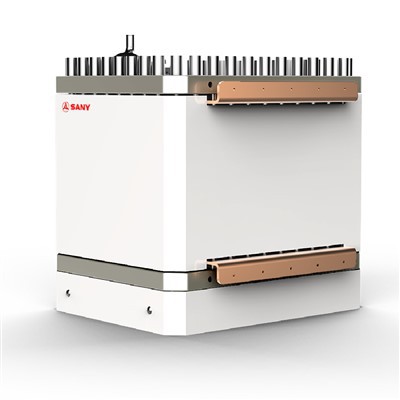
Proton Exchange Membrane Electrolyzer
Preferred PEM membrane electrodes of international leading level
Strong expandability
Advantage
1. Compact Design
Featuring a high operating current density of 1.5~3A/cm² and a core tank area thickness of less than 1m, alongside a skid-mounted integrated auxiliary control system.
2. Exceptional Efficiency
With DC power consumption below 4.3 kWh/Nm³ and thermal efficiency exceeding 75%, complemented by top-tier PEM membrane electrodes of international acclaim.
3. Robust Scalability
Offering a compatible assembly program and tailored design to accommodate various tank parameters, all seamlessly integrated on a skid-mounted platform.
4. Swift Responsiveness
Boasting rapid start-up times with hot starts taking a mere 5 seconds and cold starts under 300 seconds, adaptable to load fluctuations ranging from 5-120%. Additionally, verified cyclic start/stop performance and prolonged lifespan.
5. Unparalleled Safety Measures
Incorporating a self-developed dual-wire sealing design program and comprehensive multi-gas sensor monitoring with alarm interlock. Further enhanced with precise pressure, temperature parameter control, and hydrogen production circuit logic.
Technical Specifications and Performance
1. Enhanced Hydrogen Production Capability
This PEM electrolyzer showcases an impressive hydrogen production capability of 200Nm3/h per cell, catering to large-scale industrial needs while seamlessly integrating with clean power systems.
2. Streamlined Energy Efficiency
Beyond its stellar productivity, this electrolyzer emphasizes energy efficiency by consuming only 4.3kWh/Nm3 of DC power, a notable reduction compared to traditional models. This not only slashes production costs but also underscores a firm commitment to sustainable practices.
3. Elevated Hydrogen Purity Levels
Pre-purification, hydrogen purity exceeds 99.9%, reaching beyond 99.999% post-purification. Such exceptionally high purity levels are crucial for fuel cell applications and a myriad of other sectors.
4. Consistently Stable Operating Parameters
4.1. Operating Pressure: Maintaining a steady 3.0 MPa operating pressure ensures that the produced hydrogen aligns with this standard, accommodating diverse operational scenarios and curtailing additional pressurization expenses.
4.2. Operating Temperature: Exceptionally stable and adaptable within the range of 70±5℃, guaranteeing consistent performance under varying conditions.
5. Wide Tolerance to Power Fluctuations
With a broad power adjustment range from 5% to 110%, the electrolyzer can seamlessly operate amidst significant fluctuations in the power system.
6. Rapid Start-Up Capabilities
Equipped with swift hot and cold start functionalities, cold starts require less than 5 minutes, minimizing production downtimes. Meanwhile, hot starts take a mere 5 seconds, swiftly attaining optimal operational conditions.
|
Name |
Parameter |
|
Hydrogen production capacity (Nm3/h) |
200 |
|
Peak hydrogen production capacity (Nm3/h) |
240 |
|
DC power consumption (kWh/Nm3) |
≤4.3 |
|
Hydrogen purity (Before purification) |
≥99.9% |
|
Electrolyzer Enclosure– W x D x H(m) |
0.8x0.6x1.5 |
|
Operating pressure (MPa) |
3 . 0 |
|
Operating temperature (℃) |
70±5 |
|
Ambient Temperature (℃) |
5~40 |
|
Power consumption range |
5-1 2 0 % |
|
Cold start time (Minute) |
≤5 |
|
Hot start time (Second) |
5 |
|
Service life (Year) |
≥5 |
|
Electrolyte |
H2O |
|
Separation Unit |
|
|
Rated oxygen processing capacity |
100 Nm3/h |
|
Oxygen purity (rated operating conditions) |
>99.8%(0.2 MPa);>98.5%(3 MPa) |
|
Oxygen outlet temperature(℃) |
70±5 |
|
Purification Unit |
|
|
Hydrogen purity (After purification) |
≥99.999% |
|
Dew point of hydrogen |
-70℃ |
|
Hydrogen outlet temperature |
Ordinary temperature |
Scope of Application
Producing green hydrogen from wind and solar power: Used for the scenarios of green hydrogen produced from large-scale wind power generation, photovoltaic power generation and wind-solar complementary power generation projects to reduce the curtailment of green power.
Transportation: Due to its compact size and high efficiency, it is applicable for hydrogen refueling stations for fuel cell electric vehicles, providing rapid and sustainable hydrogen fuel supply for fuel cell electric vehicles and promoting the development of clean transportation.
Laboratory and research applications: Providing high-purity hydrogen for laboratories to study hydrogen production technology and test the performance of hydrogen fuel cells.
The proton exchange membrane (PEM) electrolyzer is a device that uses a proton exchange membrane to split water into hydrogen and oxygen, which is also known as electrolysis realized on the basis of electricity. The hydrogen produced can be used as fuel for various applications, including fuel cells, transportation, industrial production and energy storage.
Technical specifications:
PEM electrolysers are designed for efficient, reliable and durable production of high-purity hydrogen. Key technical specifications include:
- Type of electrolysis: Proton exchange membrane (PEM)
- Power supply: DC power
- Electrolyte: Water
- Operating pressure: 10-30 bar
- Peak efficiency: 85%
Advantages:
1. Cost-effectiveness: The PEM electrolyzer is an affordable hydrogen production solution that lowers the cost of hydrogen production by using renewable energy.
2. High purity: This product is committed to high-purity hydrogen production, which is critical for applications requiring high-quality gas.
3. Energy-efficiency: The PEM electrolyzer is an energy-saving solution that requires electricity and water only for hydrogen production, which ensures less carbon footprint based on its low energy consumption.
4. Easy to operate: The PEM electrolyzer is easy to operate and control at the central panel, which is convenient and user-friendly.
Applications:
1. Energy storage: The hydrogen produced can be stored in the form of gas or liquid and used as an energy source.
2. Transportation: To produce hydrogen for fuel cell electrical vehicles.
3. Industrial production: To produce hydrogen for industrial processes where the high-quality gas is required.
4. Fuel cells: To produce hydrogen for fuel cells to power homes, commercial buildings and vehicles.
Conclusion:
The PEM electrolyzer is a product that meets the global needs in this era, which provides a cost-effective, energy-saving and environment-friendly solution for hydrogen production. The equipment is committed to high-quality hydrogen production which can be applied for various purposes. We are devoted to providing our customers with cutting-edge technologies that meet the needs of the earth in the future.
Hot Tags: proton exchange membrane electrolyzer, China proton exchange membrane electrolyzer manufacturers, suppliers, factory, Hydro Compressor, New Arrival Pem Electrolyzer, Alectrolysis Alkaline, 2000 Alkaline Water Electrolysis Hydrogen Production Equipment, Square Design Hydrogen Production By Alkaline Water Electrolysis, Square Design Alkaline Hydrogen Electrolyzers
Previous
Pem Electrolyzer StackYou Might Also Like




Send Inquiry

