



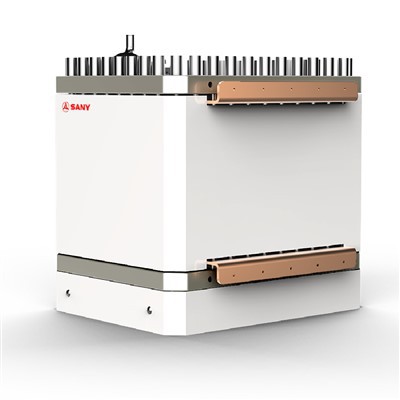
Hydrogen Pem Electrolyser
Compatible assembly program
Designed to meet the needs of different tank parameters
Advantage
Small volume
- High operating current density (1.5~3A/cm²)
- Thickness of the core area of the tank less than 1m
- Skid-mounted integrated auxiliary control system
High efficiency
- DC power consumption below 4.3 kWh/Nm³
- Thermal efficiency higher than 75%
- Preferred PEM membrane electrodes of international leading level
Technical Specifications and Performance
1. Enhanced Stability in Operational Parameters
1.1 Sustained Operating Pressure: The electrolyzer maintains a stable working pressure of 3.0 MPa, ensuring the consistent production of hydrogen at this pressure level. This adaptability caters to diverse operational requirements and minimizes the need for additional pressurization, thereby reducing associated costs.
1.2 Optimal Operating Temperature: Operating within a temperature range of 70±5℃, the electrolyzer exhibits exceptional stability and adaptability, ensuring reliable performance across varying environmental conditions.
2. Extended Range of Power Fluctuations
Flexible Power Adjustment: The electrolyzer accommodates a broad power adjustment range spanning from 5% to 110%. This extensive range enables the system to operate seamlessly even amidst significant fluctuations in power supply, ensuring uninterrupted hydrogen production.
3. Rapid Start-Up Technology
Swift Hot and Cold Start-Up: With quick start-up capabilities, the electrolyzer minimizes production downtime. Cold starts require less than 5 minutes, significantly reducing the period of stagnation in production. Additionally, hot starts take a mere 5 seconds, allowing the equipment to swiftly attain its optimal operating condition, thereby enhancing operational efficiency.
|
Name |
Parameter |
|
Hydrogen production capacity (Nm3/h) |
200 |
|
Peak hydrogen production capacity (Nm3/h) |
240 |
|
DC power consumption (kWh/Nm3) |
≤4.3 |
|
Hydrogen purity (Before purification) |
≥99.9% |
|
Electrolyzer Enclosure– W x D x H(m) |
0.8x0.6x1.5 |
|
Operating pressure (MPa) |
3 . 0 |
|
Operating temperature (℃) |
70±5 |
|
Ambient Temperature (℃) |
5~40 |
|
Power consumption range |
5-1 2 0 % |
|
Cold start time (Minute) |
≤5 |
|
Hot start time (Second) |
5 |
|
Service life (Year) |
≥5 |
|
Electrolyte |
H2O |
|
Separation Unit |
|
|
Rated oxygen processing capacity |
100 Nm3/h |
|
Oxygen purity (rated operating conditions) |
>99.8%(0.2 MPa);>98.5%(3 MPa) |
|
Oxygen outlet temperature(℃) |
70±5 |
|
Purification Unit |
|
|
Hydrogen purity (After purification) |
≥99.999% |
|
Dew point of hydrogen |
-70℃ |
|
Hydrogen outlet temperature |
Ordinary temperature |
Scope of Application
Producing green hydrogen from wind and solar power: Used for the scenarios of green hydrogen produced from large-scale wind power generation, photovoltaic power generation and wind-solar complementary power generation projects to reduce the curtailment of green power.
Transportation: Due to its compact size and high efficiency, it is applicable for hydrogen refueling stations for fuel cell electric vehicles, providing rapid and sustainable hydrogen fuel supply for fuel cell electric vehicles and promoting the development of clean transportation.
Laboratory and research applications: Providing high-purity hydrogen for laboratories to study hydrogen production technology and test the performance of hydrogen fuel cells.
Structure and Principles of PEM Electrolyzers
Introduction
(1) The PEM water electrolyzer uses a proton exchange membrane to isolate the gas on both sides of the electrode, to overcome the disadvantage of alkaline electrolysis hydrogen production membranes in terms of the permeability of gas.
(2) Main equipment include the PEM electrolyzer and BOP;
(3) This model costs more in current conditions;
Introduction to PEMWE
The PEM water electrolyzer utilizes solid proton exchange membrane (PEM) as the electrolyte and pure water as the reactant. Due to the low permeability of hydrogen, PEM electrolysis is capable of producing high-purity hydrogen that requires the removal of water vapor only, of which the process is simple and safe. The electrolyzer is designed in a zero-spacing structure with lower ohmic resistance, which significantly improves the overall efficiency of the electrolysis process in a more compact size. It supports a wider range of pressure regulation, with the hydrogen output pressure up to MPa-grade, which is adaptable to the renewable energy power input that is changing rapidly.
1. Principles of PEM Electrolyzers
Like the fuel cell stack, this type of electrolyzer is made up of membrane electrodes, plates and gas diffusion layers. The anode of a PEM electrolyser works in a highly acidic environment (pH≈2) and under the electrolysis voltage of 1.4~2.0 V, in which most non-noble metals will corrode and may combine with sulfonate ions in PEM, thus reducing the proton conduction ability of PEM.
2. Catalysts
The research on electrocatalysts in PEM electrolyzers mainly focuses on noble metals/oxides such as Ir and Ru and binary and ternary alloys/mixed oxides based on them, and titanium-based catalysts as carriers. Currently, the loading of iridium catalysts at the anode is about 1 mg/cm2, and the loading of Pt of the Pt/C-based catalysts at the cathode is about 0.4~0.6 mg/cm2. The Ir0.7Ru0.3Ox catalyst prepared by the Italian research team can make the electrolytic cell achieve 3.2 A·cm–2@1.85 V when the Ir loading is 1.5 mg/cm2. The Ir0.38/WxTi1-xO2 catalyst prepared by the Giner research team make the electrolytic cell achieve 2 A cm-2@1.75 V when the Ir loading is 0.4 mg/cm2, and the Ir content is only 1/5 of the traditional electrodes. The total loading of platinum group catalysts at the membrane electrodes should be reduced to 0.125 mg/cm2.
Ru has superior intrinsic OER catalytic activity than Ir, but Ru is less stable. Alloying Ru with Ir can improve the activity and stability of catalysts. The Ir0.6Sn0.4 catalyst prepared by the Dalian Institute of Chemical Physics, Chinese Academy of Sciences can achieve 2 A cm–2@1.82 V in the full electrolyzer test. IrSn forms a stable solid solution structure, and the process of alloying with Sn improves the dispersibility of Ir, thus helping reduce the Ir loading.
The National Renewable Energy Laboratory of the United States and Giner have jointly developed a variety of metal-organic framework (MOF) catalysts, which only costs 1/20 of the traditional catalysts. When the Co-MOFG-O catalyst is at 0.01 A/cm2, the overpotential will be 1.644 V (vs. RHE), which outperforms traditional Ir catalysts in the half-cell decay test, with full-cell tests to be done.
3. PEM and Membrane Electrodes
The most widely used membranes in PEM electrolyzers include Nafion (DuPont), the Dow membrane (The Dow Chemical Company), Flemion (Asahi Glass Co., Ltd.) and Aciplex-S (Asahi Chemical Industry Company), Neosepta-F (Deshan Chemical) and others. The DSMTM membrane developed by Giner has been produced on a large scale, which is better in terms of mechanical properties, thinness, stable dimensions during power fluctuations, start-up and shutdown, and better performance in actual electrolysis cells than Nafion. Domestic PEM products are at the trial stage.
The anode of PEM water electrolysis should be corrosion-resistant to acid environment and high potential, which should have a proper hole structure to allow gas and water to pass through. Due to the restricted reaction conditions of PEM water electrolysis, membrane electrode materials (such as carbon materials) commonly used in PEM fuel cells cannot be used for the anode of water electrolysis. 3M has developed a nano-structured thin film (NSTF) electrode, which uses Ir and Pt catalysts at the anode and cathode, respectively. The loading of Ir and Pt is 0.25mg/cm2. This electrode can work stably in an acidic environment and under high potential conditions. Its rod-like array structure on the surface improves the surface dispersibility of catalysts. Proton adopts the direct spray deposition approach to reduce agglomeration of catalysts, which makes the Pt/C and Ir with of 0.1 mg/cm2 and Ir O2 of 0.1 mg/cm2 deposited at the Nafion117 membrane. The performance of one electrolytic cell is similar to that of conventional electrolytic cells with high loading of catalysts (1.8 A cm–2@2V), which can work stably for 500 hours at 2.3 V.
SANY Hydrogen Energy Assembly Workshop
The expansive workshop spans 216 meters in length and 72 meters in width, with three distinct zones covering a combined area of approximately 15,000 square meters. Zone A is dedicated to our forthcoming machine processing line, slated for inauguration in 2024. Zone B houses our hydrogen refueling station assembly line, boasting an annual capacity of 20 sets of hydrogen refueling stations. Meanwhile, Zone C hosts our hydrogen producing equipment assembly line, capable of producing 2GW alkaline water electrolyzers annually. The construction of this entire production line commenced in January 2023 and was swiftly completed, showcasing both the agility of SANY and our prowess in equipment manufacturing.
1. Welding Robot Work Station
Scheduled for availability in September 2023, the welding robot work station represents a milestone achievement by the SANY Robotics R&D team. This innovative station integrates a truss unstacking system, robotic handling system, laser welding system, visual recognition system, and bipolar plate flipping system. Every 5 minutes, a bipolar plate undergoes seamless welding with the electrode mesh, followed by its swift transfer down the assembly line. This fully automated process, from feeding to welding, not only enhances efficiency but also standardizes operations, minimizing damage to bipolar plate coatings during handling and rotation, thereby elevating product quality.
2. Spot Welding of Round Tablets
Utilizing spot welding for round tablet fixation surpasses traditional gluing methods in several key aspects. Firstly, it eliminates detachment issues, as observed with adhesive-based methods vulnerable to alkali solution melting and peeling during electrolyzer operation, potentially compromising performance. Secondly, it ensures secure fixation, reducing the risk of misalignment or falling during assembly. Lastly, it boosts efficiency by eliminating the need for drying time associated with traditional gluing methods, thereby streamlining the assembly process.
3. PPS Separator CNC Cutter
Deployed in August 2022, the A6-2525 automated PPS separator cutter offers an effective operation area of 2500 mm×2500 mm. Featuring infrared positioning, high precision linear guide rails, and pinions, this cutter achieves cutting accuracy within ± 0.5 mm. Equipped with a 12.5 KW fan for vacuum adsorption, it ensures consistent cutting by flattening the separator. An automatic feeding device facilitates unmanned feeding and cutting, as the flattened separator seamlessly conveys to the cutting station.
4. Electrode Laser Welding Process
Operational since December 2022, the automatic electrode laser welding machine boasts PLC control and compatibility for electrodes ranging from 1000 to 2500 mm. Utilizing a robust 1500W or higher continuous laser welding unit, it ensures precise welding with minimal Z-axis unevenness. The rotary table, shifting less than 0.5 mm on the Z-axis, maintains focal length consistency during welding. The arc-like design of the pressing block fully secures parts, while trial programming enables automated skipping of hollow sections during welding. Laser welding with filler wire guarantees ± 0.5 mm accuracy, yielding even, delicate, and smooth welding seams with a bright, white surface finish.
Hot Tags: hydrogen pem electrolyser, China hydrogen pem electrolyser manufacturers, suppliers, factory, Square Design Electrolysis System, Skid Mounted Compressor, Hydrogen Production and Refueling Integrated Station, Rounnd Design Electrolysis Hydrogen Generator, Advanced Square Design Alkaline Water Electrolyzers, Square Design Alkaline Electrolysis System
Previous
Water Electrolysis PemYou Might Also Like




Send Inquiry

