2000Separation System Purification System(001)(001)
1/6
Advanced Alkaline Water Electrolysis
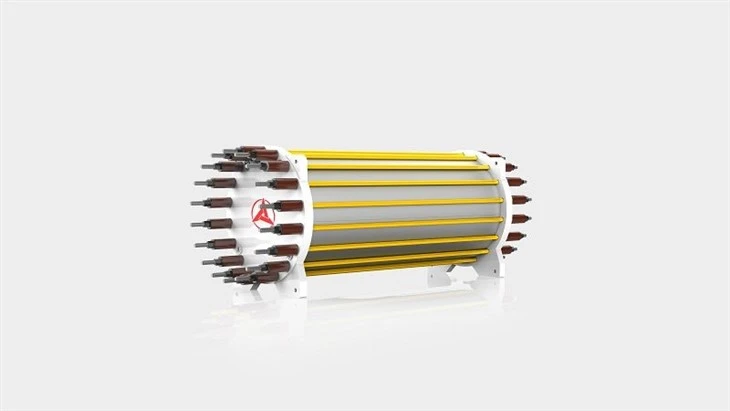
The hydrogen production capacity of this alkaline electrolyzer is up to 2000Nm³/h, which can meet the needs of large-scale industrial hydrogen and promote the development of clean-energy production.
Send Inquiry
Product Introduction
2000 Nm3/h Alkaline Water Electrolyzer
Advantage
1. Enhanced Stability
- We prioritize stability by meticulously selecting electrodes renowned for their high activity and durability, ensuring optimal energy efficiency and prolonged electrolyzer lifespan. Additionally, industry-leading membranes with exceptional airtightness and minimal surface resistance are employed to maintain gas purity while minimizing energy consumption. Leveraging advanced electrochemical emulation models and DOE methodology, we analyze and optimize the flow and temperature uniformity within the electrolyzer structure, ensuring consistent performance and efficiency. Moreover, our state-of-the-art testing platform, the world's largest of its kind, facilitates rigorous testing of electrolyzers and hydrogen production systems, providing crucial data for rapid verification and iterative enhancements. With stringent manufacturing standards inherited from SANY, we implement precise control over plate manufacturing and assembly processes, further elevating product quality.
2. Superior Energy Efficiency
- Our AWE hydrogen production equipment achieves exceptional energy efficiency with a low DC power consumption of ≤4.3 kWh/Nm³ and a comprehensive power consumption of ≤4.9 kWh/Nm³. By harnessing Raney nickel electrodes, we enhance current density by 20%, maximizing energy utilization. Moreover, our equipment exhibits remarkable adaptability to fluctuations in renewable energy sources, with automated parameter adjustments enabling seamless operation within a wide power fluctuation range of 30~120%. Additionally, our independently developed alkaline heating circulation system significantly reduces cold start duration by 50%, ensuring swift operational readiness. Continuously advancing towards intelligence, our products undergo digital and intelligent upgrades, ushering in a new era of intelligent operation and maintenance at the application end.
Technical specifications and performance
1. High production capacity with the hydrogen production capacity of 2000 Nm3/h
The hydrogen production capacity of this alkaline electrolyzer is up to 2000Nm³/h, which can meet the needs of large-scale industrial hydrogen and promote the development of clean-energy production.
2. Low energy consumption with the DC power consumption ≤4.4 kWh/Nm³
In addition to high production capacity, low energy consumption is also one of the important indicators in evaluating the quality of hydrogen production equipment. The DC power consumption of this huge circular electrolyzer is ≤ 4.4kWh/Nm³, which is much more efficient than other similar products in terms of energy consumption.
3. High purity with the purity of ≥99.8% before purification, and of ≥99.999% after purification
In hydrogen energy applications, the purity of hydrogen directly affects its application in different fields. This huge circular electrolyzer is able to produce high-purity hydrogen, of which the purity is up to more than 99.8% before purification, and even of more than 99.999% after purification.
4. Stable operation with the working pressure of 1.8 MPa and the working temperature of 90±5℃
In large-scale production, the stable operation of equipment is critical. The working pressure of this huge circular electrolyzer is 1.8 MPa, and the working temperature is maintained at 90±5℃, which not only ensures the normal operation of the equipment, but also provides users with safer and more reliable production environment, helping enterprises to maintain efficient operations.
5. Flexible control with the power fluctuation range of 30-120%
In actual production, flexible control of equipment is an important guarantee for adapting to different working conditions. The power fluctuation range of this huge circular electrolyzer is wide from 30% to 120%, ensuring that the equipment can run efficiently under various working conditions.
Name
Specifications
Hydrogen production capacity (Nm³/h)
2000
kg/24 hours
4280
Standard scope of work (%)
30~120
DC power consumption (kWh/Nm3)
≤4.4
Hydrogen purity (before purification)
≥99.8%
Hydrogen purity (after purification)
≥99.999%
H₂O-H₂ content (PPM)
≤2.54
Electrolyzer enclosure - W x D x H (m)
7.16×2.89×2.94
Working pressure (MPa)
1.8
Working temperature (℃)
90±5
Environment temperature (℃)
5~45
Electrolyte (%KOH)
30
Scope of Application
As the cost of green power represented by wind power/photovoltaic declines gradually, the large-scale application of green hydrogen is getting economically feasible (60%-70% of the cost of green hydrogen production from electricity bills). According analysis and prediction, green hydrogen may be applied to transportation, industry, hydrogen energy storage, and hydrogen-powered medical services/laboratory.
In the short term (before 2025), the application of green hydrogen will be seen in fuel cell vehicle industry cluster, demonstration applications of low-cost green hydrogen in regional industries/transportation, and hydrogen-powered medical services/laboratory (mainly PEM models).
In the long term (after 2025), the application of green hydrogen will focus on the large-scale utilization in industry, hydrogen energy storage, and transportation.
Discussion on Water Electrolysis Experiment
Supplies: Hoffman electrolyzer, DC power supply (or lead-acid battery), wires, test tubes, alcohol lamps, gas pipes, induction coils, electric keys, iron stands, iron clamps, gas bottles, and glass sinks.
Dilute sulfuric acid, hydrogen, oxygen, wood strips. principle
Water can be decomposed into hydrogen and oxygen under the action of direct current. When an electric spark passes through a mixture of hydrogen and oxygen, they combine to form water. Both experiments show that water is composed of two elements, hydrogen and oxygen. From the experimental results, we can also know that their volume ratio is 2:1.
Prepare 1. Assembling the Hoffmann electrolyzer The Hoffmann electrolyzer is composed of two graduated glass tubes of 50 ml each. Each has a piston at the upper end and is connected to a tee tube at the lower end. The bottom of the scale tube is plugged tightly with a rubber stopper embedded with a platinum electrode, and a spherical funnel tube is connected to the middle glass tube of the tee tube.
If you do not have a Hoffmann electrolyzer, you can use two acid burettes. At the lower end of the buret, install a rubber stopper with an electrode and a right-angled glass tube. Electrodes can be made of nickel-chromium wire, copper sheets or stainless steel sheets. Two right-angle glass tubes are connected with a T-shaped tube, and a funnel tube is connected for injecting electrolyte. A simple device can use only two burettes, stand them upside down in the water tank, and insert an electrode into each tube mouth. But when you want to test the hydrogen and oxygen generated by electrolyzing water, you must take the burette out of the water tank and check it upside down.
If you don't even have a buret, you can assemble it with two glass tubes about 40 cm long and 1 cm in inner diameter. A single-hole plug equipped with a glass tube is installed on the upper end, and a short glass tube is connected to a sharp-nosed tube about 4 cm long as an exhaust tube, and a spring clamp is used to control the air flow. A rubber stopper with an electrode and a right-angled glass tube is installed at the lower end. The right-angled glass tube is then connected to the T-shaped tube and funnel tube. The volume of gas obtained in the glass tube can be measured using a scale plate. First, hold one end of the glass tube with the pointed nose downward and vertically, remove the rubber stopper with the electrode, pour 3 ml of water, make the liquid higher than the opening of the glass tube on the rubber stopper, and draw a line along the liquid surface. Add another 20 ml of water and draw a line along the liquid surface. Pour out the water, place the glass tube horizontally on a piece of white paper, and draw the distance between the two lines marked on the glass tube into 20 equal parts. Each equal part represents 1 ml and mark it with a number. Assemble the required parts and fix them on the wooden board together with the marking paper to become a water electrolyzer.
In order to facilitate the detection of hydrogen and oxygen obtained after electrolyzing water, a rubber tube is often connected to the upper end of the glass tube containing the cathode with a curved pointed glass tube to allow the hydrogen to flow out slowly. Use a rubber tube to connect an empty calcium chloride drying tube to the glass tube containing the anode, so that the outflowing oxygen can accumulate in it.
2. Assemble the water synthesizer. Water synthesis is often carried out in a gas measuring tube. It is a thick-walled glass tube with a length of about 45 cm and an inner diameter of about 1.3 cm. One end is closed and the other is open. Insert two platinum wires into the closed end, with the wire ends about 2 to 3 mm apart. There is a scale on the tube, and there are two types: 25 ml and 50 ml. If you don't have such a trachea tube, you can assemble it yourself. Take a thick-walled glass tube about 40 to 45 cm long and 1.2 to 1.5 cm in inner diameter, and install a rubber stopper with two copper wire electrodes inserted into the upper end. Leave the copper wire in the plug about 3 cm long, bend 1 cm upward into a hook, connect it with a tungsten wire taken from a waste light bulb (you can also use a thin electric heating wire instead), clamp it tightly, and fix it on the between two copper wires. The copper wire outside the rubber plug is also about 3 cm long and rolled into a circle to connect to the wire.
In the hydration synthesizer assembled in this way, the rubber plug at the glass tube mouth must be tightly plugged, otherwise the plug will be ejected from the tube mouth by the expanding gas when hydrogen and oxygen explode. The volume of gas in the glass tube can be measured with the scale plate made by the above method, but it can be simpler, as long as it is divided into 4 equal parts. Turn the glass tube together with the stopper upside down, add water into it four times, 3 ml each time, put a rubber band on the outside of the tube along the horizontal surface and make four marks.
Add: 200m East of the Intersection of East 12th Road and Nanzhuyuan Road, Huanghua Town, Changsha County
SANY Intelligent Connected Truck Parts and Construction Machinery
News Letter
Enter in your e-mail address to receive deals and cupons