



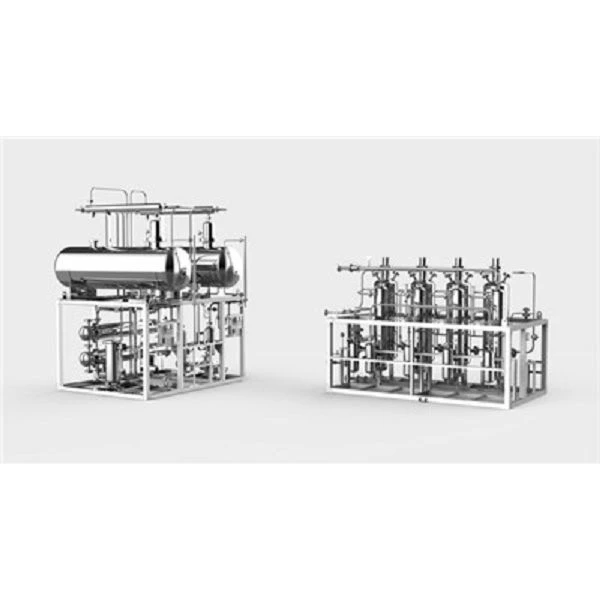
Rounnd Design Alkaline Electrolyzer
Your Leading SANY Hydrogen Energy Co., Ltd. Supplier
Focusing on the R&D, manufacturing and sales of hydrogen producing and refueling equipment and key components for a closed-loop full ecological industrial chain featured by green power, hydrogen energy and end-use equipment, SANY Hydrogen Energy Co., Ltd. is the world's leading provider of package solutions for hydrogen energy equipment, which is committed to providing global customers with GW-level ultra-large-scale package solutions on-grid/off-grid hydrogen production from wind and solar energy.
Why Choose Us?
High quality
Our products are manufactured or executed to very high standards, using the finest materials and manufacturing processes.
Competitive Price
We offering a higher-quality product or service at an equivalent price. As a result we have a growing and loyal customer base.
Global shipping
Our products support global shipping and the logistics system is complete, so our customers are all over the world.
Rich experience
Our company has many years of production work experience. The concept of customer-oriented and win-win cooperation makes the company more mature and stronger.
After-sale service
Professional and thoughtful after -sales team, let you worry about us after -sales Intimate service, strong after -sales team support.
Advanced equipment
A machine, tool or instrument designed with advanced technology and functionality to perform highly specific tasks with greater precision, efficiency and reliability.
Related Product

2000 Alkaline Water Electrolysis Hydrogen Production Equipment
Upgraded fastening system reducing the leakage of electrolyzer under alternating working conditions.

500 Alkaline Water Electrolysis Hydrogen Production Equipment
New flow-field design with simulation testing features for flow uniformity in fuel cells
New-generation electrodes with industry-leading resistance overpotentials
Comprehensive power consumption ≤4.9 kWh/Nm³.

1200 Alkaline Water Electrolysis Hydrogen Production Equipment
New flow-field design with simulation testing features for flow uniformity in fuel cells
New-generation electrodes with industry-leading resistance overpotentials
Comprehensive power consumption ≤4.9 kWh/Nm³.

1000 Alkaline Water Electrolysis Hydrogen Production Equipment
New flow-field design with simulation testing features for flow uniformity in fuel cells
New-generation electrodes with industry-leading resistance overpotentials
Comprehensive power consumption ≤4.9 kWh/Nm³.

1500 Alkaline Water Electrolysis Hydrogen Production Equipment
Double security with internal and external sealing
Upgraded fastening system reducing the leakage of electrolyzer under alternating working conditions.

Multi-in-one Alkaline Electrolyzer Hydrogen Producing Equipment
As the star product of SANY Hydrogen Energy, the all-in-one AWE hydrogen production equipment consists of four 1,000 Nm3/h electrolyzers and one 4,000 Nm3/h separation and purification system, providing users with an unprecedentedly efficient hydrogen production experience.

3000 Square Design Electrolyzers
This Square AWE equipment has a huge hydrogen production capacity of up to 3000 Nm³/h, which can provide powerful support for application scenarios with high demand for hydrogen energy and reliable guarantee for large-scale applications in the hydrogen energy industry.

Square Design Alkaline Water Electrolyzers
The hydrogen production capacity of this square AWE equipment is up to 1000Nm3/h per cell. The huge production capacity not only meets the high demand for hydrogen energy of some application scenarios, but also promotes the development of large-scale hydrogen energy industry.

Square Design Alkaline Hydrogen Electrolyzers
This Square AWE equipment has a huge hydrogen production capacity of up to 3000 Nm³/h, which can provide powerful support for application scenarios with high demand for hydrogen energy and reliable guarantee for large-scale applications in the hydrogen energy industry.
What is Round Design Alkaline Electrolyzer?
Alkaline electrolysers are typically composed of electrodes, a microporous separator and an aqueous alkaline electrolyte of approximately 30.
Benefits of Round Design Alkaline Electrolyzer
High efficiency: Alkaline electrolysis has a high efficiency for converting electrical energy into hydrogen gas. The efficiency can be as high as 80%, which means that 80% of the electrical energy input can be converted into hydrogen gas.
Scalability: Alkaline electrolysis can be scaled up or down depending on the size of the hydrogen production facility needed. This makes it suitable for a wide range of applications, from small-scale hydrogen production for fuel cells to large-scale industrial hydrogen production.
Renewable energy source: Alkaline electrolysis can be powered by renewable energy sources such as wind and solar power, making it a clean and sustainable way to produce hydrogen.
High-purity hydrogen: Alkaline electrolysis produces high-purity hydrogen gas, which is suitable for a wide range of applications, including fuel cells and chemical production.
Low operating costs: Alkaline electrolysis is relatively inexpensive to operate, as it does not require expensive catalysts or high temperatures to operate. This makes it an attractive option for hydrogen production, especially in areas with low electricity costs.
Safe and environmentally friendly: Alkaline electrolysis does not produce any greenhouse gas emissions or other harmful pollutants, making it a safe and environmentally friendly way to produce hydrogen.
Application of Round Design Alkaline Electrolyzer
Feedstock:
Hydrogen is widely used as a feedstock in various industries and sectors and serves as a key component in the production of chemicals, in refineries, steel manufacturing and power generation. Producing Hydrogen through alkaline water electrolysis enables these industries to decarbonise.
Chemical industry:
Hydrogen is a crucial feedstock, serving as a building block for the synthesis of a variety of chemical compounds and used in the production of ammonia, methanol, hydrogen peroxide and various organic compounds.
Refineries:
Hydrogen is utilised in refineries for hydroprocessing, where it is combined with heavy petroleum fractions to remove impurities and improve the quality of fuel products.
Steel production:
Hydrogen is employed in the iron and steel industry as a feedstock to reduce iron ore in to metallic iron in a process called direct reduction. This reduces carbon emissions associated with traditional production processes.
Power generation:
Hydrogen can be used as a feedstock for power generation through the utilisation of fuel cell technologies, which convert hydrogen in to electricity, usable as a clean energy source.
Mobility:
The use of hydrogen in mobility applications facilitates the transition to low-carbon transportation and the reduction of greenhouse gas emissions. It offers the advantage of providing a clean and sustainable energy source for a wide range of vehicles and transportation methods such as buses, trucks, taxis, personal cars, and even trains and ships. Hydrogen fuel cell vehicles enable longer range and quicker refuelling times when compared to battery electric vehicles, crucially also reducing weight.
Fuel:
By converting renewable electricity into hydrogen through alkaline water electrolysis, hydrogen as a fuel can be stored and transported over long distances, buffering and balancing the intermittent nature of renewable electricity supplies. This fuel can then be used for power generation, steam production or even to replace natural gas in domestic heating applications.
Main Differences Between Alkaline Electrolyzers and Other Types of Electrolyzers
There are several key differences between alkaline electrolyzers and other types of electrolyzers, including:
Electrolyte
Alkaline electrolyzers use a liquid potassium hydroxide (KOH) electrolyte, whereas other types of electrolyzers use solid polymer electrolytes or acidic electrolytes.

Efficiency
Alkaline electrolyzers have a higher energy efficiency than other types of electrolyzers, meaning they require less energy to produce a given amount of hydrogen.

Operating temperature
Alkaline electrolyzers operate at higher temperatures than other types of electrolyzers, typically between 70°C and 100°C.
Hydrogen purity
Alkaline electrolyzers can produce high-purity hydrogen without the need for additional purification steps.
The alkaline water electrolyzer typically operates at ∼60–80 °C with a corresponding thermodynamic voltage for water splitting of 1.20–1.18 V. The terminal cell voltage of an alkaline water electrolyzer is 1.8–2.4 V at the typical operational current density of 0.2 to 0.4 A cm−2.
An alkaline electrolyzer is a device that uses an electrolyte solution, typically potassium or sodium hydroxide, to split water molecules into hydrogen and oxygen through a process called electrolysis. The chemical principle behind an alkaline electrolyzer is based on the principles of electrochemistry. In electrochemistry, chemical reactions are driven by the transfer of electrons from one substance to another. When an electrical current is applied to an electrolyte solution, it causes the electrolyte solution to undergo a process called electrolysis. During this process, the electrical current causes the water molecules to be split into their constituent atoms of hydrogen and oxygen.
In an alkaline electrolyzer, the process is made possible by the presence of the electrolyte solution, which contains hydroxide ions (OH-) that facilitate the transfer of electrons between the electrodes and the water molecules. The hydroxide ions are attracted to the positively charged anode (the electrode connected to the positive terminal of the power source) and the hydrogen ions (H+) are attracted to the negatively charged cathode (the electrode connected to the negative terminal of the power source).
● At the anode, water molecules are oxidized to form oxygen gas and positively charged hydrogen ions: 2H2O → O2 + 4H+ + 4e-
● At the cathode, hydrogen ions are reduced to form hydrogen gas: 4H+ + 4e- → 2H2
● Overall, the reaction can be expressed as: 2H2O → 2H2 + O2
The electrolyte solution plays an important role in the process by providing a conductive medium for the flow of electrons between the electrodes and the water molecules. The hydroxide ions in the electrolyte solution also help to maintain a stable pH level, which is important for the efficient functioning of the electrolyzer.
Electrocatalyst Development for Alkaline Water Electrolysis
The activity of the electrocatalyst depends on several physicochemical properties of the material, including the composition, conductivity, electronic and crystal structures, morphology and textural parameters, as well as the preparation method, grain boundaries, surface structure, and the presence of defects. The performance of the electrocatalyst can be boosted either by increasing the number of active sites on a given electrode, through enhanced loading or altering structural properties to expose more catalytic active sites per gram, or manipulating the intrinsic activity of each active site by keeping the mass constant. The catalyst materials must fulfill some basic requirements and criteria to be considered for large-scale applications. On the one hand, it should be efficient and provide a high current density at low applied potential, should have good structural durability and stability under operating conditions, and should be cost-effective. On the other hand, the figure of merit of the catalyst should be holistic and take into account other key aspects during the electrocatalyst design including sustainability, criticality (covering supply and geopolitical risks of raw materials), ecology, and recyclability. It is very essential to prioritize sustainability and recyclability in every stage of production, considering the limited resources and depletion of many elements in the near future. It is also worth noting that the electrocatalytic performance of a catalyst is highly dependent on the experimental conditions and measurement techniques. For a more detailed understanding of electrocatalytic properties and performance indicators, as well as a protocol for evaluating the activity and stability of OER catalysts, one can refer to other review articles.
Why Is the Part Load Limit Range of Alkaline Water Electrolysers Spanning 10% to 25%?
This is related to the management of the alkaline electrolyte: either through separate circuits for the oxygen and hydrogen streams or through a common path.
The mixture of gas and electrolyte for each electrode is always routed separately to separators to extract most gas but some residual gas (intended gas and impurities) remains embedded in the liquid. If the electrolyte streams leaving the separators are mixed before being fed back to each electrode, there is a mixing of residual gases and an increase in residual hydrogen on the oxygen-producing side as well as an increase in residual oxygen on the hydrogen-producing side, thereby increasing contamination level and imposing a shutdown at a higher load. This setup would typically call for a shutdown near the 25% limit.
Keeping the electrolyte streams independent after the separators prevents such added contamination and pushes the safety limit closer to the 10% load limit. However, this solution comes with its own drawbacks: water consumption on the hydrogen-producing side (cathode) increases electrolyte concentration, while water production on the oxygen-producing side (anode) decreases electrolyte concentration. Some liquid level balancing and electrolyte concentration balancing is still required to maintain pumping capability (liquid level) and optimal electrolyte concentration (electrolyser efficiency depends on electrolyte conductivity). For example, using NaOH as electrolyte, peak conductivity is ~65 S/m at 50°C and reached for a concentration just below 20%mas, while using KOH, peak conductivity is ~95 S/m at 50°C and reached for a concentration just above 30%mas.
Our Factory
Focusing on the R&D, manufacturing and sales of hydrogen producing and refueling equipment and key components for a closed-loop full ecological industrial chain featured by green power, hydrogen energy and end-use equipment, SANY Hydrogen Energy Co., Ltd. is the world's leading provider of package solutions for hydrogen energy equipment, which is committed to providing global customers with GW-level ultra-large-scale package solutions on-grid/off-grid hydrogen production from wind and solar energy.


FAQ
Hot Tags: rounnd design alkaline electrolyzer, China rounnd design alkaline electrolyzer manufacturers, suppliers, factory, Rounnd Design Electrolysis Hydrogen Generator, Proton Exchange Membrane Electrolyzer, Alectrolysis Alkaline, Pem Green Hydrogen Electrolyser, Hydrogen Pem Electrolyser, Hydrogen Energy Equipment
Previous
Bop System EquipmentYou Might Also Like




Send Inquiry

