



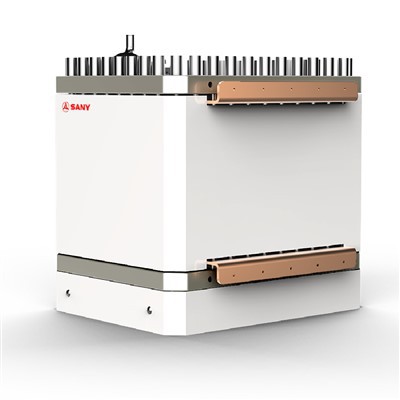
Water Electrolysis Pem
Thermal efficiency higher than 75%
Preferred PEM membrane electrodes of international leading level
Strong expandability
Advantage
1. Compact Design
- High operating current density (1.5~3A/cm²)
- Core tank area thickness less than 1m
- Integrated auxiliary control system on skid-mounted platform
2. Superior Efficiency
- DC power consumption below 4.3 kWh/Nm³
- Thermal efficiency exceeding 75%
- Utilizes PEM membrane electrodes of top international quality
3. Scalability
- Flexible assembly program
- Tailored design for various tank parameters
- Integration onto skid-mounted platforms for easy expansion
4. Rapid Response
- Hot start within 5 seconds, cold start within less than 300 seconds
- Adaptable to load variations ranging from 5-120%
- Verified performance and lifespan through cyclic start/stop testing
5. Unparalleled Safety
- Innovative dual-wire sealing design
- Comprehensive multi-gas sensor monitoring and alarm interlock system
- Precise control of pressure, temperature, and hydrogen production circuit logic for enhanced safety measures
Technical Specifications and Performance
1. Enhanced Hydrogen Production Capacity
Each cell of this PEM electrolyzer boasts a hydrogen production capacity of 200Nm3/h, facilitating large-scale industrial applications and bolstering clean power integration efforts.
2. Energy-Efficient Operation
With a focus on productivity and sustainability, this electrolyzer consumes a mere 4.3kWh/Nm3 of DC power, significantly less than conventional models. This design not only reduces production costs but also aligns with sustainable development goals.
3. Elevated Hydrogen Purity
Prior to purification, hydrogen purity exceeds 99.9%, reaching upwards of 99.999% post-purification. Such high-purity hydrogen is indispensable for fuel cell applications and other critical fields.
4. Consistent Operating Parameters
4.1 Working Pressure: Operating at 3.0 MPa ensures that produced hydrogen is readily compatible with various applications, minimizing the need for further pressurization and associated costs.
4.2 Operating Temperature: Operating at a stable 70±5℃ ensures exceptional stability and adaptability of the electrolyzer.
5. Wide Power Fluctuation Range
Capable of adjusting power from 5% to 110%, this electrolyzer can effectively operate amidst significant fluctuations in the power system, ensuring continuous operation.
6. Rapid Start Technology
Featuring quick start capabilities, with cold starts taking less than 5 minutes, minimizing production downtime. Hot starts are accomplished in a mere 5 seconds, swiftly achieving optimal operational conditions.
|
Name |
Parameter |
|
Hydrogen production capacity (Nm3/h) |
200 |
|
Peak hydrogen production capacity (Nm3/h) |
240 |
|
DC power consumption (kWh/Nm3) |
≤4.3 |
|
Hydrogen purity (Before purification) |
≥99.9% |
|
Electrolyzer Enclosure– W x D x H(m) |
0.8x0.6x1.5 |
|
Operating pressure (MPa) |
3 . 0 |
|
Operating temperature (℃) |
70±5 |
|
Ambient Temperature (℃) |
5~40 |
|
Power consumption range |
5-1 2 0 % |
|
Cold start time (Minute) |
≤5 |
|
Hot start time (Second) |
5 |
|
Service life (Year) |
≥5 |
|
Electrolyte |
H2O |
|
Separation Unit |
|
|
Rated oxygen processing capacity |
100 Nm3/h |
|
Oxygen purity (rated operating conditions) |
>99.8%(0.2 MPa);>98.5%(3 MPa) |
|
Oxygen outlet temperature(℃) |
70±5 |
|
Purification Unit |
|
|
Hydrogen purity (After purification) |
≥99.999% |
|
Dew point of hydrogen |
-70℃ |
|
Hydrogen outlet temperature |
Ordinary temperature |
Scope of Application
1. Laboratory and Research Applications
Trusted for delivering high-purity hydrogen, this electrolyzer serves laboratories engaged in hydrogen production technology research and hydrogen fuel cell performance testing. Providing researchers with a reliable source of high-purity hydrogen, it accelerates advancements in hydrogen-related technologies, fostering innovation and scientific discovery.
2. Green Hydrogen Production from Renewable Sources
Utilized in large-scale wind power generation, photovoltaic power generation, and wind-solar complementary power generation projects, this electrolyzer efficiently produces green hydrogen, mitigating the curtailment of renewable energy. By harnessing wind and solar power, it contributes to sustainable energy practices and reduces reliance on fossil fuels.
3. Transportation Sector Integration
Its compact design and superior efficiency make it ideal for hydrogen refueling stations catering to fuel cell electric vehicles (FCEVs). By facilitating rapid and sustainable hydrogen fuel supply, it supports the growth of clean transportation initiatives. Fostering the adoption of FCEVs, it contributes to reducing greenhouse gas emissions and enhancing air quality in urban environments.
Proton Exchange Membrane Water Electrolysis for Hydrogen Production
As the technology is gradually industrialized, the asbestos separator in the alkaline electrolyzer has been replaced by the proton exchange membrane that can conduct protons.
Advantage 1: At the same time, the proton exchange membrane can insulate and isolate gas with a pole-free structure, which is safer to produces hydrogen with a purity of 99.99%.
Advantage 2: This model is compact in size with a large current density of 2A/cm2. It consumes less energy at 4kWh/Nm3H2, adjusts pressure within a wider range, and responds better. There are mass-production models in the overseas market, but China is just about to develop this technology. Related research mainly focuses on the electrocatalysts, membrane electrodes and diffusion layers.
1. Research on electrocatalysis
PEM water electrolysis involves the hydrogen evolution at the cathode and oxygen evolution at the anode. In commercial cases, Pt/C particles (similar to fuel cells) are used as the catalyst at the cathode, which is prone to degrade. In the SPE water electrolytic cell, C-carried catalysts tends to degrade due to the oxidation of C in a highly acidic (pH≈2) environment and at a high potential of 1.4~2.0 V. Transition metals such as Mn, Co, and Ni are highly soluble, which may further adhere to the membrane and combine with the sulfonate ions in the membrane, thereby reducing the proton conductivity of the membrane. Oxygen evolution catalysts pose a challenge to such research. By far, research focuses on IrO2-RuO2, which aims for a decrease in the use of precious metal catalysts can be reduced by 30%-50% by alloying such precious metal.
2. Research on membrane electrodes
In general cases, the catalyst is coated on the proton exchange membrane. The preparation, catalytic layer structure, catalyst activity, concentration and dispersion of Nafion in the slurry of membrane electrodes are closely related to the macroscopic performance of the electrolytic cell. In this regard, the order-structured membrane electrodes are a popular topic of research. For now, water, electrons, and proton channels are disordered in catalysts, carriers, and slurry polymers. The ordered-structure design of catalysts, carriers, and polymers may ensure efficient and smooth channels for water, electrons, and protons, which is key to lowering costs and elevating energy density.
3. Research on diffusion layers
Used for mass transfer for O2 and H2O, the diffusion layer at the anode requests a high potential and acidic environment, which requires the corrosion-resistant coating. Porous titanium is generally used as the base. Sintered porous titanium plates and titanium fiber felts are superior in performance. Titanium plates generally have a porosity of 30% and a minimum thickness of 0.6mm. Titanium felts have a porosity of 70% and a minimum thickness of 0.2mm, which is often used for the diffusion layer at the anode. Titanium felts are usually coated with precious metal alloys, such as 20-150nm Ir by means of ion sputtering, for better resistance to corrosion, which means a higher cost in current conditions.
SANY Hydrogen Energy Beijing R&D Testing Center
The SANY Hydrogen Energy Beijing R&D Testing Center was established in August 2022, commencing full operations in April 2023. Spanning an area of approximately 500 square meters and boasting a total investment nearing RMB 6 million yuan, the center is dedicated to advancing the quality of hydrogen energy equipment.
With a primary objective of enhancing hydrogen production through water electrolysis, the Center prioritizes the development of essential technologies. It actively supports SANY Hydrogen Energy in creating advanced, high-performance, and durable electrolyzer products. Bolstered by a team of seasoned industry experts and a dedicated research and laboratory staff comprising doctoral and master's degree holders, the Center possesses formidable research and development capabilities.
Presently, the Center houses two state-of-the-art development and testing platforms for the core components of AWE and PEM hydrogen production equipment. Equipped with a diverse array of cutting-edge instruments and equipment, including self-developed testing platforms for electrodes/membranes, PEM test benches, hot presses, ICP-OES, fluorescence spectrum analyzers, electrochemical workstations, small-scale electrolyzers, plasma spraying, sandblasting, and more, these platforms facilitate comprehensive research and development, testing, and small-batch trial production.
Furthermore, recognizing the absence of relevant testing standards and the significant variability in experimental results using conventional methods, the Center has independently designed and developed the industry's sole testing platform for critical components like electrodes and membranes. Through extensive research and experimentation, it has established meticulous testing methodologies to address the complexities and fluctuations inherent in such components. This comprehensive approach ensures a multidimensional assessment of critical core component performance, effectively fostering their advancement and stability.
SANY Hydrogen Energy is esteemed by global clientele for its superior overseas after-sales service system. Supported by the Overseas Business Department of SANY Group, we pledge to deliver comprehensive hydrogen production and refueling services, inclusive of on-site maintenance, technical support, and personnel training.
Hydrogen Production Equipment Service Program
1. On-site Maintenance and Technical Support
1.1 Design and Technical Assistance:
- Collaborating with designers to finalize detailed designs.
- Participation in design review and engineering coordination meetings organized by purchasers.
1.2 On-site Services:
- Supervising on-site installation of provided equipment.
- Overseeing initial start-up commissioning and equipment package delivery.
- Provision of thorough technical training for maintenance personnel.
1.3 After-sales Support:
- Addressing and troubleshooting equipment quality or operational failures within 24 hours.
- Offering spare parts manufacturer information, aiding in model selection and procurement.
- Furnishing complimentary technical services prior to warranty expiration.
2. Training
2.1 Technical Instruction and Support:
- Conducting equipment installation and commissioning.
- Training users' technicians and operators during on-site service term.
2.2 Operational Support:
- Providing prompt, high-quality operational assistance to ensure equipment functions smoothly.
- Supplying updates on latest technology developments and newly available parts.
Hydrogen Refueling Equipment Service Program
1. Warranty
1.1 Quality Standards and Criteria:
- Ensuring equipment, materials, and components meet relevant specifications and national standards.
- Performance meeting parameters outlined in technical and manufacturing standards.
1.2 Warranty Duration:
- One-year warranty period post-acceptance.
- Committed to free repair for faults and damages caused by human error, along with replacement of failed parts during warranty.
2. On-site and After-sales Services
2.1 Response and Service Timelines:
- Guaranteed response within 2 hours and on-site inspection and maintenance within 24 hours during the warranty period.
2.2 Engineering Design and Construction Oversight:
- Collaborating with equipment manufacturers and design institutes for technical guidance.
- Sending engineers and technicians for on-site civil construction supervision to ensure adherence to technical requirements and design.
2.3 Equipment Delivery, Installation, and Acceptance:
- Guiding equipment hoisting and positioning, supporting preliminary acceptance.
- Providing technical assistance and communication for on-site equipment interfaces.
- Offering commissioning plans, conducting system commissioning, and preparing commissioning and acceptance reports during completion and acceptance.
Hot Tags: water electrolysis pem, China water electrolysis pem manufacturers, suppliers, factory, Hydraulic Pump Air, Advanced Square Design Alkaline Water Electrolyzers, Pem Electrolysis System, Square Design Alkaline Electrolysis System, Alkaline Water Electrolysis, Square Design Electrolyzer Alkaline
Previous
Pem Hydrogen ElectrolysisYou Might Also Like




Send Inquiry

